
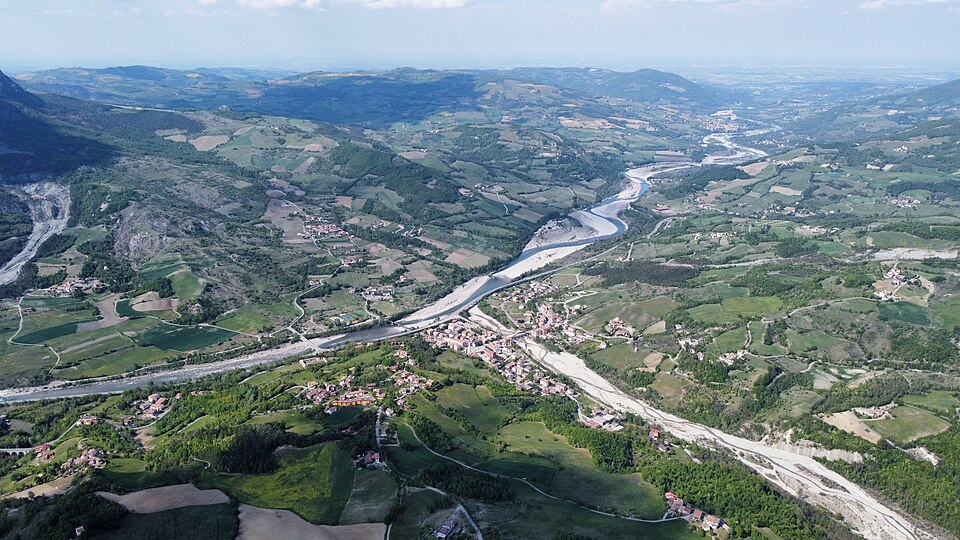
Middle Trebbia Valley, at the confluence of the Perino stream and the Trebbia River. Photo: Alerove / Wikimedia Commons, CC BY-SA 4.0 (credit as given in the original document).
1. WHY START IN THE PIACENZA VALLEYS
The hills and mountains of the province of Piacenza are home to organic farms, often small operations working fragmented plots under more difficult conditions than those of the plain. The market does not always adequately recognise the value of their produce.
Alongside their agricultural production, these valleys may have a distinctive environmental feature: their position on the southern edge of the Po Valley and, under some weather conditions, air masses arriving from the south across the Apennine watershed may create different atmospheric exposure patterns from those on the plain.
This has not been demonstrated for all valleys, nor is there a permanent barrier to pollution from the Po Valley. Topography, slope orientation, altitude, season and weather can create substantial differences even between nearby places. Lower exposure remains a hypothesis to be tested.
2. THE ATMOSPHERIC HYPOTHESIS TO TEST
The Po Valley is affected by emissions from cities, industry, farming and transport, alongside weather conditions that favour the accumulation of pollutants in some seasons. Certain parts of the Piacenza Apennines may be less exposed to particular air masses, while others may experience airborne transport and deposition.
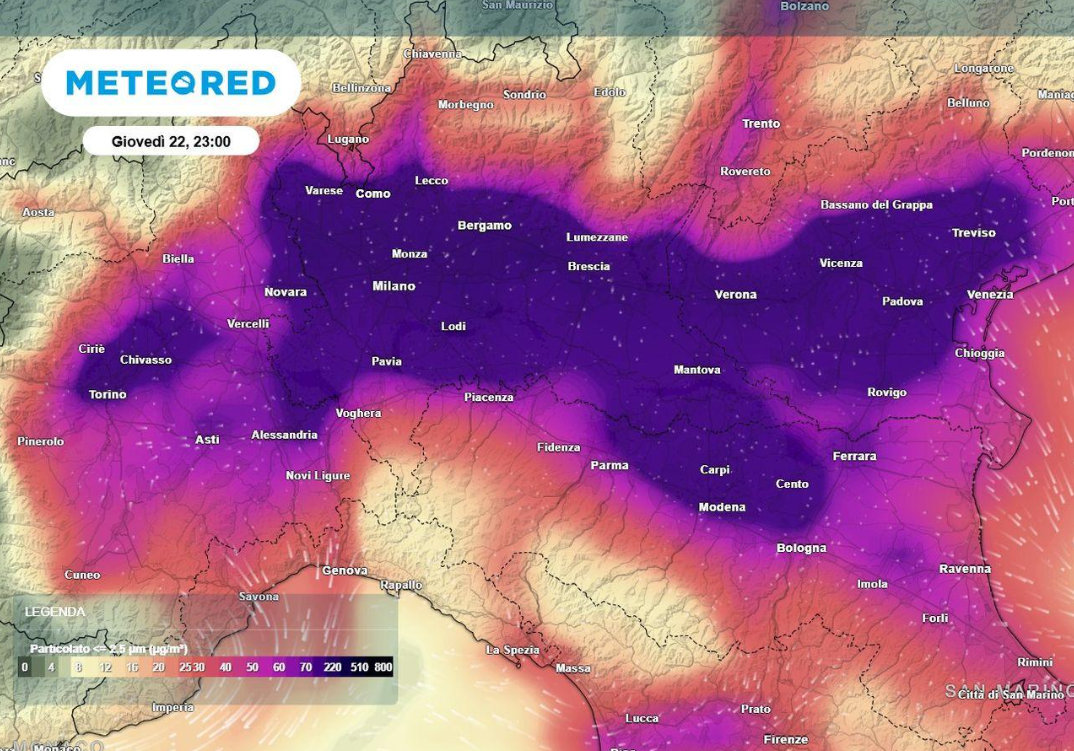
Example Meteored forecast map of PM2.5 for a single hour (“Thursday 22, 11 p.m.”; month and year not visible in the original). It illustrates a temporary contrast between the plain and higher ground but is NOT a historic measurement, a seasonal average or evidence of soil quality. The 800 µg/m³ figure is the upper end of the colour scale, not a measured concentration in Piacenza.
The first local aim is to assess where and when a contrast may exist between the plain, the foothills and the hills or mountains, and whether it corresponds to measurable differences in agricultural soils, water and biological indicators. Relatively cleaner air does not, by itself, establish that a field is less contaminated.
To examine this hypothesis, the local project will use weather records and historical air-quality data where available at sufficient resolution, together with information on emission sources and previous land use. The results will be compared with environmental investigations in selected individual areas.
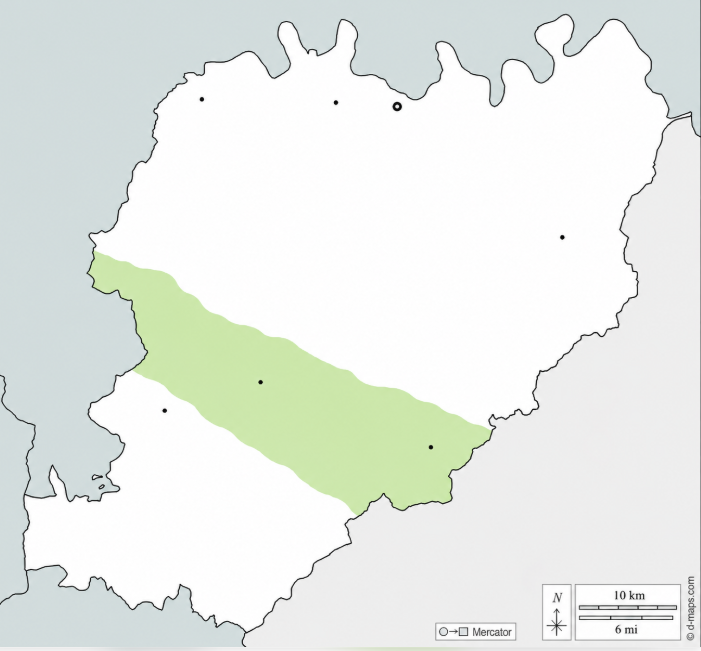
A band of the Piacenza Apennines potentially less exposed to air pollution from the Po Valley. This hypothesis will be tested scientifically. Areas farther south have not been prioritised because of extensive woodland and relatively limited cultivated land.
3. AN ECONOMIC OPPORTUNITY FOR ORGANIC FARMING IN PIACENZA
In the hills and mountains around Piacenza, working small and often separate plots can mean practical difficulties, higher unit costs and smaller harvests than those achievable on the plain. Organic practices may impose additional costs that are not always reflected in selling prices.
TrustyFood aims to create a real opportunity to add value: identify local organic products with market potential and examine whether their growing areas enjoy particularly favourable environmental conditions. If environmental and product tests produce satisfactory results, scientific documentation could become a commercial advantage for sales online in Italy and abroad.
The commercial objective is to improve participating farms’ profitability through supply agreements and purchase terms potentially better than traditional channels. No price premium is guaranteed: prices, quantities, continuity of supply and economic viability will be agreed with each producer.
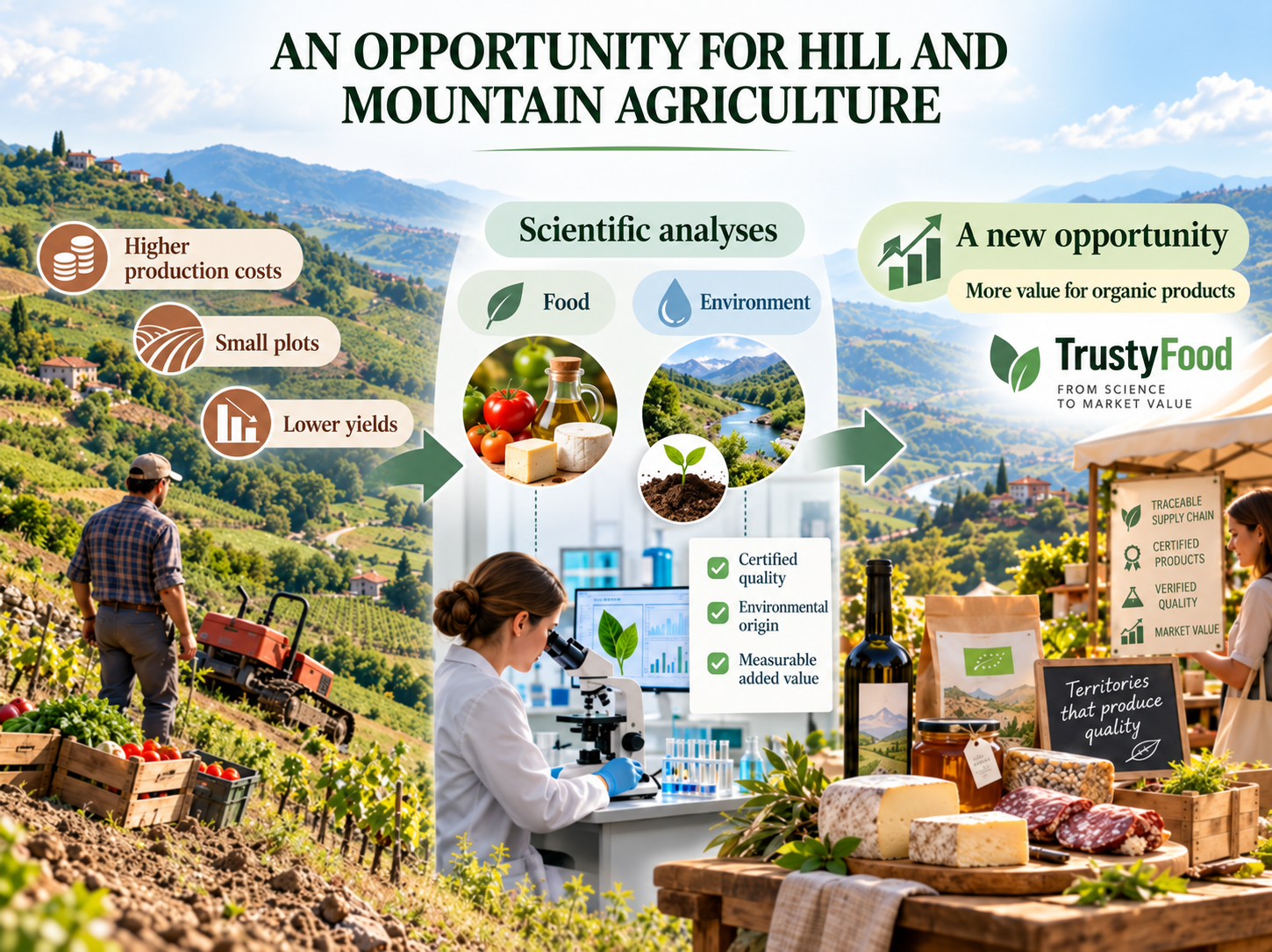
Adding value to organic farming in hilly and mountainous areas: production challenges, scientific verification and possible market recognition. Illustration from the original regional document.
4. HOW TO SELECT THE FIRST PILOT AREA
Rather than choosing the valley assumed to be cleanest, the starting point will be discussions with organic farms and their associations. We will consider crops, available volumes, processing opportunities, supply conditions and real commercial interest for TrustyFood.
Only after this initial assessment will we identify a specific area comprising accurately mapped fields and their relevant surroundings. Selection will consider geography and geology, exposure to winds, possible comparison sites and potential sources affecting soils and water.
Investigations will follow the scientific protocol in the general LANDS OF EXCELLENCE document. This page does not repeat methods, sample types or contaminants: it describes the Piacenza hypothesis and its local application. Findings will apply only to fields and environments actually examined, not automatically to entire valleys or municipalities.
TrustyFood will cover the full cost of environmental investigations and laboratory analyses, without asking farms or associations to contribute financially. Initial interest will not create an obligation to participate or exclusivity requirements.
5. FROM LOCAL PRODUCTION TO THE TRUSTYFOOD MARKET
If environmental and product testing is favourable, TrustyFood may buy selected organic products under agreed terms, arrange processing where appropriate and market them through its online channel in Italy and abroad.
Added value will come from identifiable agricultural origin, documented environmental conditions and relevant product analyses. It is essential to distinguish the environmental quality of an area from the characteristics of its harvest; neither can be attributed to fields or batches not studied.
The possible Piacenza pilot can be presented as the first regional application of the general project, documenting the areas studied, participating producers, test results and the limits of each conclusion. The same structure would allow further regional projects without duplicating the scientific framework.
6. NEXT STEPS IN THE PIACENZA AREA
The initial phase involves contacting agricultural associations and organic farms in the Piacenza valleys, gathering information about available production and identifying the first commercially sustainable supply opportunities.
Based on these opportunities, one or more pilot areas will be selected within the municipalities of Bobbio, Coli, Farini, Travo, Bettola, Morfasso, Pianello Val Tidone, Piozzano and Gropparello, where environmental investigations and agricultural-product testing will begin.
Pilot-area selection will consider the characteristics of interested organic farms, available production, opportunities for commercial value and local conditions that might reduce exposure to human-caused pollutants.
For the full biological monitoring and analytical assessment protocol, see the general LANDS OF EXCELLENCE document.
Explore the scientific method
Read about the methodology, environmental samples and controls planned under the general project.
← Back to the general project