
TRUSTYFOOD: AN ONLINE MARKETPLACE FOR EXCEPTIONAL FOOD
TrustyFood is an Italian company aiming to create an online marketplace dedicated to exceptional food products, serving Italian and international consumers seeking superior-quality foods supported by scientific verification.
TrustyFood’s business model is based on a clear principle: food excellence should not merely be claimed; it should be demonstrated through objective, verifiable testing and controls.
TrustyFood intends to select, purchase and market foods meeting particularly stringent quality criteria, including criteria stricter than statutory requirements, while making the results of its checks available to consumers.
This is the context for LANDS OF EXCELLENCE, an initiative to identify farmland potentially enjoying especially favourable environmental conditions and to investigate those conditions scientifically.
The project has a practical commercial purpose: to identify outstanding organic agricultural products, add economic value by purchasing them from growers, and offer them in Italy and abroad through TrustyFood.
The initiative also recognises that organic farms often face higher production costs than conventional farms without always obtaining adequate prices. The problem can be especially acute for small farms and those working in less favourable production conditions.
By scientifically assessing environmental conditions and product quality, TrustyFood aims to identify distinctive characteristics that can generate recognisable added market value beyond organic certification alone.
A fundamental aim is therefore to improve the profitability of participating organic farms through potentially better purchase terms and access to a specialised online market serving Italian and international consumers prepared to pay for documented excellence.
Scientific research is not an end in itself: it becomes a practical tool for selecting and commercially enhancing agricultural production.
LANDS OF EXCELLENCE thus seeks to connect environmental quality, food excellence and economic value, creating new opportunities for organic producers and stronger quality assurances for consumers.
2. WHY THIS INITIATIVE EXISTS
Across Europe, organic farms operate in widely differing environmental settings: densely urbanised plains, industrial districts, rural areas, hills and mountains. Organic certification documents specific production practices, but it does not provide a complete assessment of soil and water quality.
Air pollution is one possible route by which human-derived substances enter farming ecosystems. Emissions from industry, transport and combustion can travel through the atmosphere and reach soil and vegetation through wet and dry deposition. Other pathways include water, past land uses and local sources.
Some contaminants—including human-derived metals, PAHs, dioxins, furans and PCBs—can persist in the environment. However, their presence in air or soil does not automatically mean significant transfer into edible crops: mechanisms differ by substance, environmental medium and plant species.
European air-quality maps reveal major geographical differences, but cannot on their own qualify a particular farming area or predict the amount of each contaminant in food.
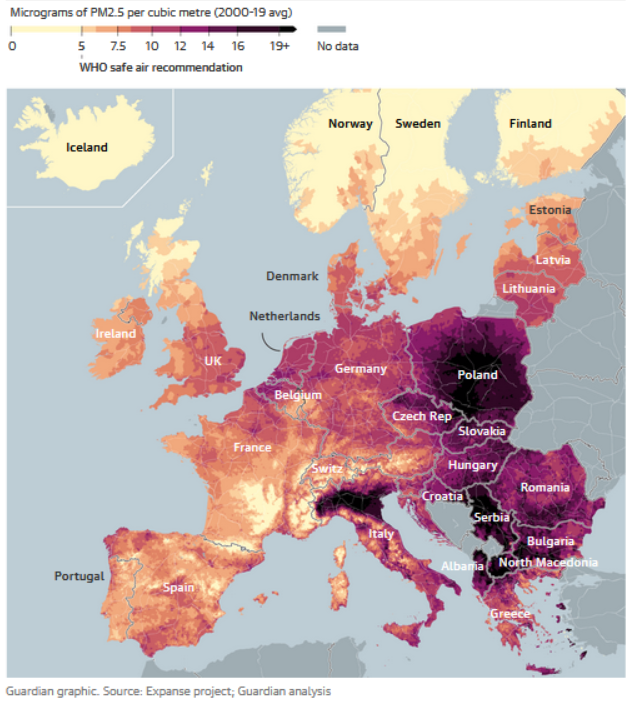
This map shows atmospheric PM2.5 distribution; it does not directly show dioxins, PCBs or contamination of soils and food.
LANDS OF EXCELLENCE seeks to identify farming areas potentially subject to lower human-caused pollution, test that hypothesis scientifically and, where the findings justify it, link environmental evidence to the commercial value of specific organic products.
An opportunity for organic farms
Carefully produced, high-quality goods do not always achieve adequate prices. TrustyFood aims to offer a business opportunity based on documented evidence—not vague claims of purity, but results tied to precisely identified fields, environmental samples and harvests.
3. OBJECTIVES AND SCIENTIFIC CRITERIA
The starting question is: are there organic farming areas in which human-derived environmental contaminants occur at particularly low concentrations? And how do those concentrations relate to those found in agricultural products?
The project does not assume that areas far from cities, at high altitude or with cleaner air are necessarily less contaminated. Such conditions may help identify candidates, but they require verification. Conversely, apparently less favourable areas may contain fields and crops with excellent analytical results.
We are not seeking completely untouched landscapes. We aim to document favourable environmental conditions using suitable methods, declared analytical limits and transparent assessment criteria. Values below the LOQ (limit of quantification: the lowest concentration that an analytical method can quantify with suitable accuracy and precision) do not mean absolute absence.
Conclusions will apply only to the areas and environmental media actually studied. Environmental qualification of an area and analytical compliance of its crops are distinct, complementary assessments.
4. HOW WE WILL STUDY SELECTED FARMING AREAS
A. Identifying and studying the area
The first stage will examine selected organic farms and the surrounding environment that may affect them.
Each area has features that influence the presence and spread of pollutants. Mountain forms, slope orientation, wind circulation and distance from emission sources can create major differences even between nearby locations.
The study will begin with a cartographic, geological and geomorphological survey of the selected land and its surroundings, taking account of natural features and atmospheric circulation.
Land-use history will also be considered, to identify past activities that may have left traces of contamination.
The relevant organic fields will be mapped precisely, with external comparison points where useful. Investigations will also consider surrounding areas that may affect air and water reaching the fields.
The aim is to understand which natural conditions and human activities have influenced the specific production areas, without extending conclusions to land not studied.
B. Biological monitoring
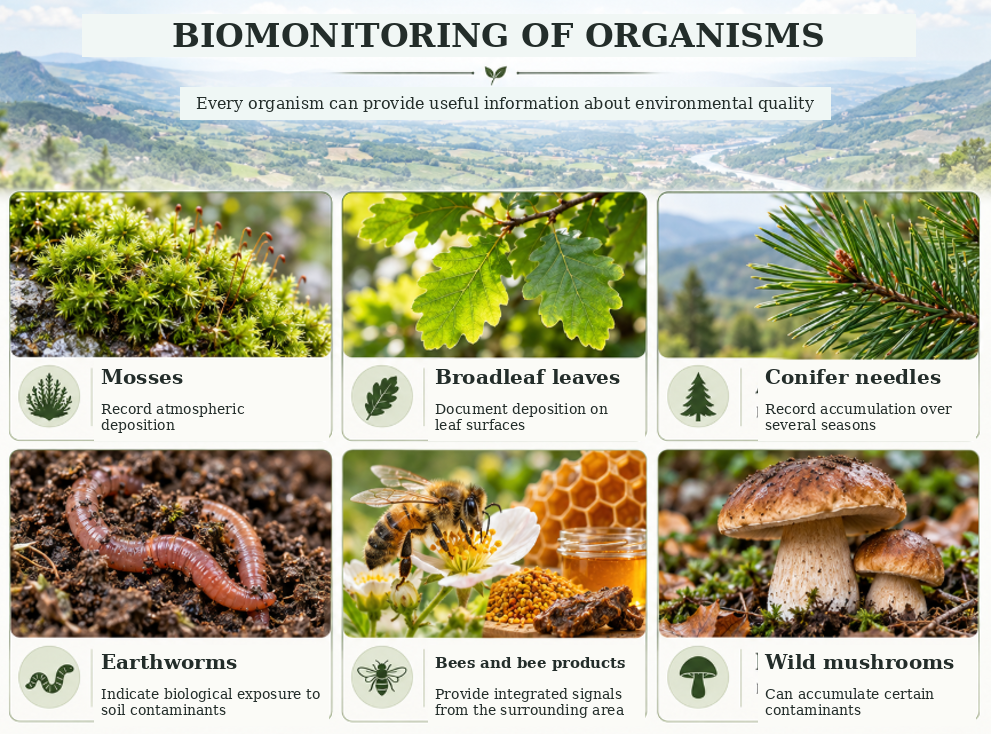
Organisms will be selected from those present locally according to the contaminants of interest, favouring established scientific methods. Different biological samples provide different information and are not automatically comparable.
| Biological sample | Sample to collect | Expected environmental information |
| Mosses | Defined growth sections, free of soil | Atmospheric deposition of metals and selected persistent contaminants |
| Broadleaf foliage | Mature leaves; species and sampling period recorded | Seasonal deposition on vegetation and, for some elements, root uptake |
| Conifer needles | Needles of different ages, kept separate | Accumulation of certain atmospheric compounds over several seasons |
| Earthworms | Whole organisms prepared under a defined procedure | Biological exposure to soil contaminants |
| Bees and hive materials – optional | Bees, pollen, wax or propolis, sampled separately | Integrated signals from the foraging area, subject to interpretative limits |
| Wild mushrooms – optional | Fruit bodies identified by species | Selective accumulation of some metals; seasonal option |
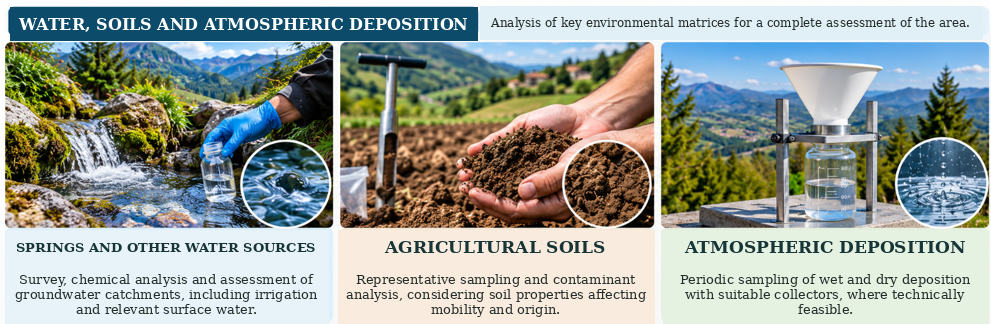
C. Water, soils and atmospheric deposition
| Environmental component | Planned activity |
| Springs and relevant waters | Inventory, chemical testing and assessment of groundwater catchments; consideration of irrigation and surface waters |
| Agricultural soils | Representative sampling; analysis of contaminants and soil characteristics relevant to their origin and mobility |
| Atmospheric deposition | Periodic collection of wet and dry deposition with suitable devices where technically feasible |
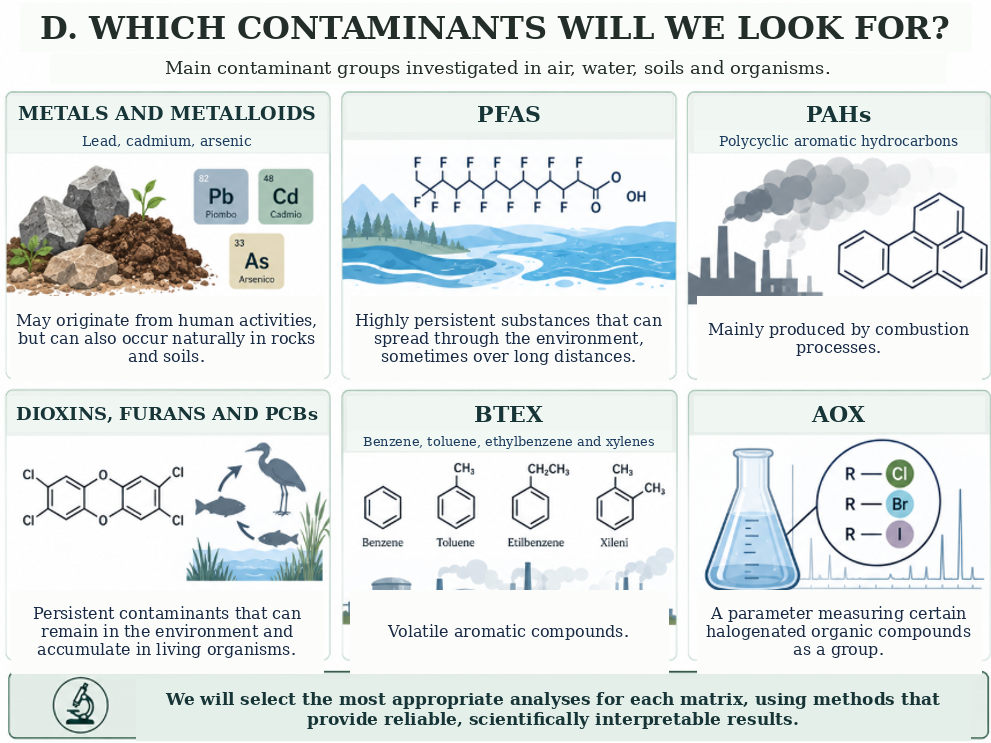
D. Contaminants of interest
The investigation will focus on substances that can reach even apparently remote environments via air, water and soil.
We will assess metals and metalloids, including lead, cadmium and arsenic, which may originate from human activities but can also occur naturally in rocks and soils.
Particular attention will be paid to PFAS, highly persistent chemicals that can spread through the environment and sometimes reach places far from where they were used.
We will also examine PAHs (polycyclic aromatic hydrocarbons), mainly associated with combustion, as well as dioxins, furans and PCBs, which may persist in the environment and accumulate in living organisms.
We will also consider BTEX—volatile aromatic compounds including benzene, toluene, ethylbenzene and xylenes—and AOX, an aggregate parameter for certain organically bound halogens.
These substances do not behave alike. Some settle on plant surfaces; others may accumulate in soil or be taken up by organisms.
We therefore will not test every sample for every substance. Analyses will be selected for each environmental medium using methods that yield reliable, interpretable results.
The aim is to build an overall picture of contamination in the selected farming areas and their surroundings using evidence from different organisms and environmental samples.
Further information about potential food contaminants is available at:
E. Interpreting results and monitoring over time
Finding a trace of a substance in soil does not automatically mean that the food crop is contaminated. Results will be interpreted against background concentrations, relevant regulatory thresholds, exposure pathways, soil characteristics and evidence of transfer into the crop. Quantitative criteria for each contaminant and sample type will be defined in a technical protocol.
The initial characterisation will be followed by periodic environmental checks and reassessment after relevant events or local changes. Food testing will be tailored to the contaminants and risks involved, avoiding both absolute-absence claims and scientifically unjustified repetition.
5. THE ROLE OF PRODUCERS
To launch LANDS OF EXCELLENCE, TrustyFood wishes to involve organic producers directly, drawing on their knowledge of local farms and their needs.
The first step will be to discuss crops, available quantities and the commercial terms of potential purchases with organic producers, aiming to offer an alternative market and better remuneration.
Only after identifying real commercial opportunities will TrustyFood select the first pilot area for environmental investigations.
TrustyFood will cover all investigation and laboratory costs, without requesting financial contributions from farmers.
Organic farms may consider participation freely, with no obligation to join and no exclusivity requirement.
Together with organic growers, we aim to turn scientifically demonstrated favourable environmental conditions into added value for local production.
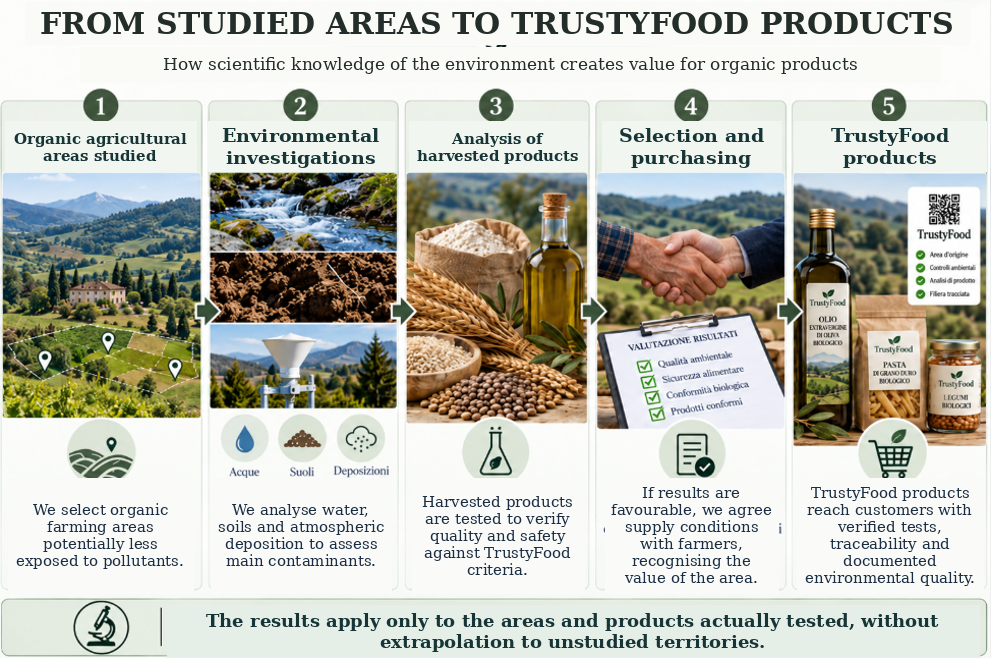
6. FROM STUDIED AREAS TO TRUSTYFOOD PRODUCTS
If environmental investigations and harvest analyses prove favourable, TrustyFood may buy products from certified organic farms in the studied areas, subject to availability and agreed commercial terms. The products may then be processed, checked and sold through TrustyFood’s online channel in Italy and abroad.
Added value will come from the combination of organic production, an accurately identified farming area, documented scientific checks and the TrustyFood brand.
The environmental quality of selected areas may be illustrated through their landscapes, springs and wildlife, but above all through the studies performed. Findings will always refer to the areas actually examined, without generalisation.
The presentation of results will distinguish documented environmental quality from analytical checks on products. No conclusions will be attributed to areas or batches that have not actually been investigated.
7. A MODEL APPLICABLE TO DIFFERENT AREAS
The project is conceived as a replicable protocol, not an initiative confined to one province or region. The overall method will remain consistent, while sampling design, biological indicators and priority contaminants will be adapted to local geography, geology, climate and production.
Each local application will depend on interested organic farms and a realistic opportunity to add value to their products. A pilot area will be chosen for environmental studies only after preliminary commercial evaluation.
Local applications—including a possible first pilot in the province of Piacenza—will be documented separately, describing regional hypotheses, analytical findings and limits of interpretation.
A project in which environmental quality creates an opportunity for organic farming and science helps add value to the products of the land.
From ideas to the field
Discover how the general project will be implemented in the Piacenza valleys.
Explore the Piacenza valleys project →Read the technical qualification criteria and sampling procedures in the project archive.
Browse the technical protocols →